
SentinelFlow Core (SFC) — Overview
SentinelFlow Core is the end-to-end system of record for manufacturers who need material planning, warehouse control, production execution, and a native financial ledger in one application—engineered for concurrent multi-user operations, not single-user spreadsheets dressed up as software.
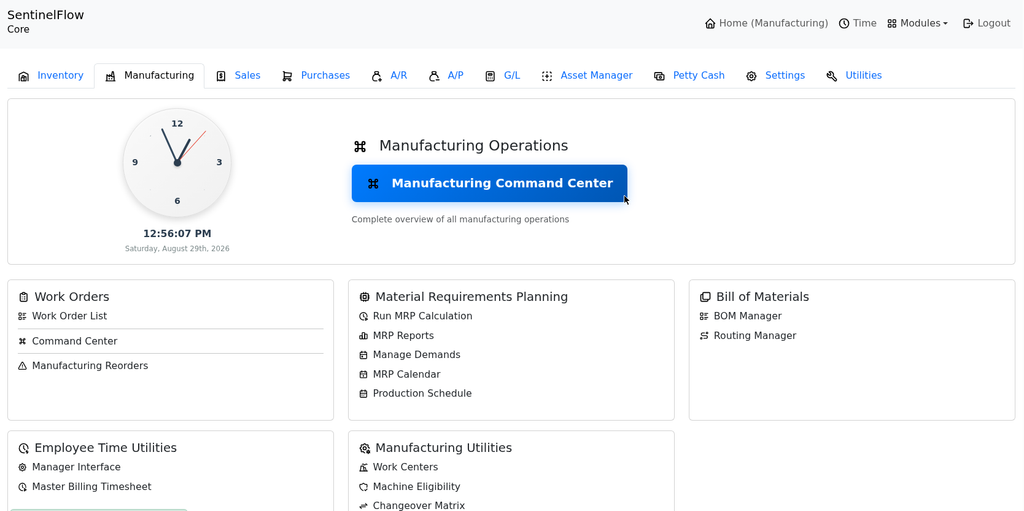
When a mid-sized manufacturer outgrows disconnected tools, the usual pain is not a missing feature list. It is contention: planners waiting on locked sessions, warehouse clerks racing each other for the same lot, and finance discovering that “available” stock was already promised twice. SentinelFlow Core was rebuilt to attack that failure mode at the architectural level. Demand, reservation, planning, purchasing, work orders, receiving, issue, production receipt, pick, ship, and invoice live in one database—with isolation and deterministic inventory logic so every concurrent user works against truth, not ghosts.
SentinelFlow Core is built for mid-to-large-scale discrete manufacturers and manufacturing distributors who need a serious operational spine: make-to-stock and make-to-order shops with bills of material, routings, multi-location warehouses, serial or lot discipline, and a chart of accounts that posts from the same documents the floor already uses.
You get a complete operational loop. Quotations become firm sales orders when you are ready. Firm orders, open jobs, reorder policy, and optional forecasts feed regenerative material requirements planning. Planned work orders and purchase orders convert into live documents. Goods are received, components are issued, finished goods are received, then allocated, picked, dispatched, and invoiced. Every quantity change writes an inventory movement ledger. When company financial linking is enabled, balanced general-ledger entries post from those same operational events.
Unlike lightweight inventory apps and spreadsheet-backed MRP packs, SentinelFlow Core treats concurrency and inventory honesty as product features, not afterthoughts. Planners can keep working while an MRP calculation runs. Document drafts for purchase orders, goods receipts, transfers, and invoices are isolated per working session. Controlled stock is reserved with row-level locking and a soft-reservation overlay that planning, picking, and fulfillment all respect. The result is an ERP you can put on a busy plant floor without teaching your team to “wait until the other person finishes.”
SentinelFlow Core plans materials, runs the warehouse and shop floor, and posts the books—in one system of record, with multi-user isolation and deterministic inventory reservation built in.
The manufacturing ERP that refuses to freeze your plant—or invent inventory you do not have.
Why SFC is Built Differently

- No session freezing while MRP is calculating—operations stay interactive.
- Advisory locking prevents conflicting MRP executions from trampling each other.
- Run-isolated planning results preserve a coherent snapshot for conversion and reporting.
- Concurrent document drafts are isolated so multi-user plants do not share one fragile clipboard.
- The same authenticated security model protects pages and application JSON endpoints.
Multi-step operational documents—purchase order entry, goods receipt, stock transfers, and vendor invoices—use isolated session workspaces keyed by unique identifiers. Two buyers can build two purchase orders at the same time. Two receiving clerks can work two receipts at the same time. Drafts do not collide, overwrite, or silently inherit another user’s unfinished lines.
Most mid-market ERP products still behave like they were designed for one power user at a time. Long calculations hold the session. Inventory screens trust optimistic reads. Two clerks can both believe they allocated the last carton. Planning tables get overwritten mid-conversation. SentinelFlow Core’s recent platform refactor turns those engineering problems into commercial differentiators.
Your planners keep working while the plan is calculating.
When material requirements planning used to run inside a classic web session, every other tab for that user could freeze until the calculation finished. In a real plant, that is unacceptable. SentinelFlow Core’s Multi-Threaded Multi-User Isolated Planning Engine closes the write lock on the user session at the start of an MRP run, so warehouse, sales, and shop-floor screens continue to respond while planning proceeds. Concurrent calculation attempts are governed by a database advisory lock: if an MRP run is already in progress, a second attempt is refused cleanly instead of corrupting shared planning state. Each successful run is stamped with a unique run identity. Requirements, supplies, planned orders, and run parameters are stored against that identity, so planning output is no longer a single disposable scratchpad that vanishes when someone else recalculates.

Planning is regenerative and deterministic. Stock does not move and the ledger does not post until a human firms planned orders and executes receiving, issue, production receipt, dispatch, or invoicing.
Ghost inventory is the silent killer of on-time delivery. It appears when systems allow two processes to believe they own the same physical quantity. SentinelFlow Core’s Zero-Trust Deterministic Inventory Reservation System refuses that model. Soft reservations for sales orders and work orders live in a dedicated allocation layer. Net available inventory is calculated as physical quantity minus open reserved quantity, not as a hopeful screen total.
Auto-allocation for lot- and serial-controlled items locks the physical lot rows before it decides what can be reserved, using first-expiry-first-out discipline where expiration dates matter. Material requirements planning subtracts open allocations from demand so planners do not re-order what the warehouse has already promised. When stock finally moves—goods receipt, transfer, adjustment, work-order issue, finished-goods receipt, or sales dispatch—the quantity change and the movement ledger are written together inside transactional boundaries, and document numbers are allocated under database locking so two stations cannot mint the same transaction identity.
- Soft reservation separates “promised” from “still free to promise.”
- Net-available inventory is a calculated truth shared by planning and fulfillment.
- Row-level lot locking during auto-allocation eliminates double-claim races on controlled stock.
- FEFO-aware selection protects shelf-life-sensitive inventory.
- Transactional stock and ledger posting keep operations and finance on the same event timeline.
- Zero ghost allocations as a design goal: reservation before movement, movement before invoice where shipping has already occurred.
Available means available—not “probably free if nobody else clicked first.”
Uncontrolled bulk stock, serial/lot-controlled stock, and warehouse bin stock are modeled explicitly.
Reservation strength is strongest where physical identity matters most—controlled and warehouse items—because that is where ghost allocations destroy trust fastest.
Who SentinelFlow Core Is For
- Discrete manufacturers with bills of material, work centres, and the need to turn sales into purchase orders and work orders without a separate MRP product.
- Manufacturing distributors that still kit, assemble, or light-manufacture.
- Multi-location plants that need location-scoped user rights and location-level on-hand.
- Finance-aware operations teams that want inventory valuation and a native chart of accounts in the same system of record.
- Organizations that prefer hosting PHP and MariaDB as a controllable single-company system—on premises or on a dedicated private server—rather than renting a multi-tenant black box.

SentinelFlow Core is not marketed as a fifty-site global cloud suite, a live carrier-rating parcel engine, or a drop-in replacement for QuickBooks Online as the only ledger. It is a manufacturing system of record for a serious plant. That focus is the product.
Stop choosing between control and concurrency.
Mid-to-large manufacturers do not fail because they lacked another dashboard. They fail when the plan freezes the session, when inventory lies, and when finance cannot trust the floor. SentinelFlow Core was engineered so those three failures stop being normal.